
Mark Reisdorf
Mark graduated from Southern Illinois University in 1969 and, after a tour in the military, went to work for Marr Knapp and Crawfis Architects and Engineers in Mansfield, Ohio. Mark worked with the architectural firm from 1972 through 1985, receiving his Ohio Architectural Registration in 1984. While with the firm Mark was responsible for specifications and project site coordination. From 1985 through 2008 Mark was a partner with Quest Interior Construction Co., specializing in commercial light gauge metal stud framing, gypsum board systems, acoustical ceiling systems, hollow metal doors and frames, and flooring. As a project manager Mark was responsible for material and labor estimating, purchasing, and project management.
Light Gauge Metal Stud Framing
Planning and Best Practices
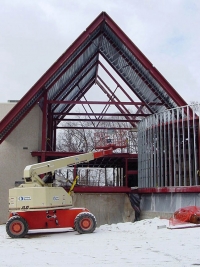
The light gauge metal stud framing phase of a project significantly impacts several other trades. It is no secret that good planning and practices will achieve higher production rates and a level of quality that meets the project's specifications. Planning and layout should be the responsibility of the project foreman; however, everyone should be involved with preparing the work flow. While actual layout is underway, other production items should also be thought through.

Lessons Learned: Installing Laminate Flooring
These are lessons learned from installing laminate flooring in my own home, along with my wife and a few friends. Laminate flooring is a relatively new and innovative product, well suited for home owners and do-it-yourself individuals who are looking for a weekend project. Fitting that description, my wife and I started our quest to redo our 12'-0" x 18'-0" family room.
Light Gauge Metal Stud Framing
Planning and Best Practices
The light gauge metal stud framing phase of a project significantly impacts several other trades. It is no secret that good planning and practices will achieve higher production rates and a level of quality that meets the project's specifications. Planning and layout should be the responsibility of the project foreman; however, everyone should be involved with preparing the work flow. While actual layout is underway, other production items should also be thought through.

Keeping Weather in Mind
To maintain a project's schedule, productivity, and ultimately, profitability, it is imperative that the job foreman and the office project manager and/or estimator are aware of weather and site conditions. During this time of the year, material delivery becomes an extremely important part of maintaining project schedules and minimizing surprises.
Specifiers tend to create their products based on what manufacturers tell them. This is not a bad idea; after all, no one has the time to research all the products used on site. Manufacturers will indicate that their materials need to be pre-conditioned to the interior temperature for a period of time, usually 24 hours prior to installation. The standard temperature is typically between 55 degrees Fahrenheit and 70 degrees Fahrenheit.
Job Site Safety
It goes without saying that everyone is responsible for their own safety, but on a job site, project managers and job foremen have a responsibility to others to make sure that the work place is safe. A great place to start is to let everyone know that safety issues are taken seriously and the primary goal is to prevent injuries and lost time.
Lessons Learned: Installing Laminate Flooring
These are lessons learned from installing laminate flooring in my own home, along with my wife and a few friends. Laminate flooring is a relatively new and innovative product, well suited for home owners and do-it-yourself individuals who are looking for a weekend project. Fitting that description, my wife and I started our quest to redo our 12'-0" x 18'-0" family room.