Robert Thimmes

Robert Thimmes

Rob Thimmes, 30 year veteran of the interior trades and 15 year owner of Homefront Construction Company, still wears his tools most days. As owner/operator of a small business, he has worn all the hats: estimator, accountant, truck driver, warehouse man, project manager, superintendent, foreman, journeyman, and laborer. When he's not on the job he enjoys writing, blacksmithing, church, his family and 'solving all the world's problems'.

Website URL:

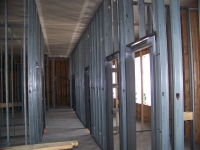
Contractor-to-Contractor: In this installment of Rob Thimmes’ series on framing walls with light gauge metal studs, he reviews the basics of hollow metal doorframe installation.

During your framing process, the question of when you should set welded hollow metal doorframes must be addressed. Many contractors prefer to install doorframes before the walls are built. This facilitates the ease of fastening the "feet" down to the floor. After the frames are fastened down, braces are required to keep wind or inadvertent contact from toppling the freestanding frames. Then, as the framers come to a pre-installed doorframe, they simply remove the braces and frame to, over, and around the assembly. Another method is to install the frames at the time the walls are built. Roughly, this method follows the same progression as the first method without the need to temporarily brace off the frame. The framers build walls until they come to a door opening; then they get down off their scaffold and set the doorframe, after which they resume framing walls. The doorframe need not be braced off when employing this method, since the doorframe is permanently attached to the studs. The drawback to this method is "switching gears": I have found that keeping crews productive and on task is easier when they don’t have to carry equipment for two separate operations and mentally bounce back and forth between them. However, the ease or advantage of either of these two methods is usually negated by late-arriving door frame deliveries (a very common problem). The last method involves setting doorframes after the walls are built. In my experience, I have found this to be the most common occurrence. It is with this last method that we will concern ourselves today.

Contractor-to-Contractor: In this installment of Rob Thimmes’ series on framing walls with light gauge metal studs, he reviews the basics of hollow metal doorframe installation.
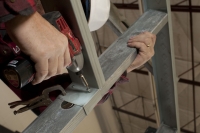
During your framing process, the question of when you should set welded hollow metal doorframes must be addressed. Many contractors prefer to install doorframes before the walls are built. This facilitates the ease of fastening the "feet" down to the floor. After the frames are fastened down, braces are required to keep wind or inadvertent contact from toppling the freestanding frames. Then, as the framers come to a pre-installed doorframe, they simply remove the braces and frame to, over, and around the assembly. Another method is to install the frames at the time the walls are built. Roughly, this method follows the same progression as the first method without the need to temporarily brace off the frame. The framers build walls until they come to a door opening; then they get down off their scaffold and set the doorframe, after which they resume framing walls. The doorframe need not be braced off when employing this method, since the doorframe is permanently attached to the studs. The drawback to this method is "switching gears": I have found that keeping crews productive and on task is easier when they don’t have to carry equipment for two separate operations and mentally bounce back and forth between them. However, the ease or advantage of either of these two methods is usually negated by late-arriving door frame deliveries (a very common problem). The last method involves setting doorframes after the walls are built. In my experience, I have found this to be the most common occurrence. It is with this last method that we will concern ourselves today.

Contractor to Contractor: Follow professional Interior Contractor Robert Thimmes as he produces a layout and final shoot-down of a metal stud track system.

Plumb, level, square, and straight: all carpentry is the same, right? Well, no. Basic building principles apply, but how you build with metal studs differs greatly from building with wood. The following discussion offers a systematic explanation of installing metal studs, with various best practices for each step.

Contractor to Contractor: Follow professional Interior Contractor Robert Thimmes as he demonstrates how to stand up and brace off walls. This second in a series of articles, Framing Walls With Light Gauge Metal Studs, starts with your walls located, lines chalked and bottom track already shot down (for details on this process, see Metal Stud Track Layout and Shoot-Down).

In the previous installment of “Contractor to Contractor,” we reviewed the details of how to perform the track layout and shoot-down for metal stud walls. Now we move on to the second part of our discussion: standing up and bracing.

Thu Feb 02 2012 2:08pm

Framing Out Openings

Contractor to Contractor: Follow professional interior contractor Robert Thimmes as he demonstrates how to frame-out openings. This third installment in a series of articles, Framing Walls With Light Gauge Metal Studs, visits the common practices for the framing of window and door openings.

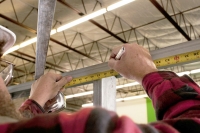
When plumbing your openings and transferring your layout to the top track, turn your stud 90 degrees and attach your level high on the stud flange. Align the bottom edge of your stud with the edge of your opening, get the bubble "dead-on" and mark the top. Attaching your level to the flange rather than the webbing gives you a straighter surface that is less prone to bow, thus reducing variables and improving quality. Since one side of your opening has been plumbed, now just measure over the actual width of the opening and mark to establish the top of the other side.
Fri Jan 20 2012 12:00am

Framing Out Openings

Contractor to Contractor: Follow professional interior contractor Robert Thimmes as he demonstrates how to frame-out openings. This third installment in a series of articles, Framing Walls With Light Gauge Metal Studs, visits the common practices for the framing of window and door openings.

When plumbing your openings and transferring your layout to the top track, turn your stud 90 degrees and attach your level high on the stud flange. Align the bottom edge of your stud with the edge of your opening, get the bubble "dead-on" and mark the top. Attaching your level to the flange rather than the webbing gives you a straighter surface that is less prone to bow, thus reducing variables and improving quality. Since one side of your opening has been plumbed, now just measure over the actual width of the opening and mark to establish the top of the other side.

Fri Jan 06 2012 12:00am

Standing Up and Bracing Off Walls

Contractor to Contractor: Follow professional Interior Contractor Robert Thimmes as he demonstrates how to stand up and brace off walls. This second in a series of articles, Framing Walls With Light Gauge Metal Studs, starts with your walls located, lines chalked and bottom track already shot down (for details on this process, see Metal Stud Track Layout and Shoot-Down).

In the previous installment of “Contractor to Contractor,” we reviewed the details of how to perform the track layout and shoot-down for metal stud walls. Now we move on to the second part of our discussion: standing up and bracing.
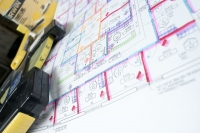
Contractor to Contractor: Follow professional Interior Contractor Robert Thimmes as he produces a layout and final shoot-down of a metal stud track system.

Plumb, level, square, and straight: all carpentry is the same, right? Well, no. Basic building principles apply, but how you build with metal studs differs greatly from building with wood. The following discussion offers a systematic explanation of installing metal studs, with various best practices for each step.
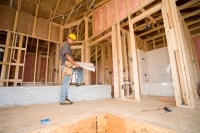
What makes for success as an interior contractor and what are the basics of staying in business? An experienced contractor takes a look at some of the misconceptions that plague the industry and brings the focus back to fundamentals that can help you understand the full value of your skill set.

Being in business in this economy means understanding the fundamentals of our industry and where it's going. As a small business owner I've seen my fair share of ups and downs. Usually most of the misunderstandings and problems can be solved by a little inquiry and a lot of listening.

Copyright © 2012 Buildipedia.com™ | All Rights Reserved
Site Designed by Kinopicz American