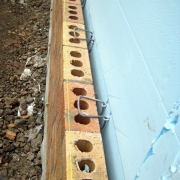
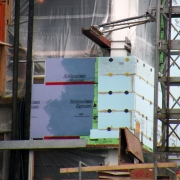
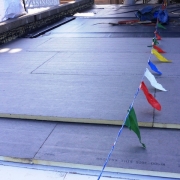
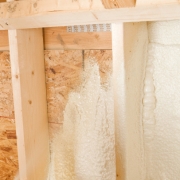
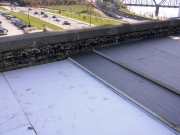
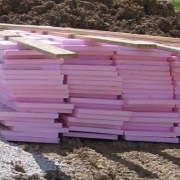
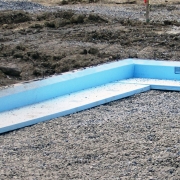
Board insulation, also referred to as foam-plastic board insulation, can be used in many areas of building construction to provide thermal resistance. It is appropriate for use under concrete floor slabs, at foundation walls, in wall cavities, as a backer material for remodeling with new siding, and in a wide range of roofing applications. Foam plastic boards encompass three types: polystyrene, polyisocyanurate, and polyurethane. All types of foam-plastic board insulation panels need to be protected from the damaging ultraviolet effects of the sun. Additionally, foam-plastic insulation should be protected from fire as it will emit dense smoke containing toxic gases. Unfaced foam-plastic insulation boards used in construction are required by codes to be completely concealed in fire resistant materials. Glass fiber resin mixtures and mineral wool are also manufactured in board products for use in construction applications. Blanket, foamed-in-place, loose-fill, blow-in and sprayed type insulations are summarized in other sections.
Polystyrene Insulation Materials
Written by The U.S. Department of Energy's Office of EERE Thu Mar 04 2010 2:40amPolystyrene — a colorless, transparent thermoplastic — is commonly used to make foam board or beadboard insulation, concrete block insulation, and a type of loose-fill insulation, which consists of small beads of polystyrene.
Extruded Polystyrene (XPS): Improved Wall Performance
Written by David Ingold Thu Feb 02 2012 2:22pmA building's wall system must constantly fight the invasion of rain, air, vapor and thermal attacks.The wall's ability to provide a barrier to each of these elements relies upon the use of appropriate materials, installed in the correct sequence. There is no such thing as a perfect wall system; however, a wall system that performs with greater efficiency using new efficient materials is achievable.
Polyisocyanurate Insulation Materials
Written by The U.S. Department of Energy's Office of EERE Thu Mar 04 2010 2:44amPolyisocyanurate or polyiso is a thermosetting type of plastic, closed-cell foam that contains a low-conductivity gas (usually hydrochlorofluorocarbons or HCFC) in its cells. The high thermal resistance of the gas gives polyisocyanurate insulation materials an R-value typically from R-5.6 to R-8 per inch.
Polyurethane Insulation Materials
Written by The U.S. Department of Energy's Office of EERE Thu Mar 04 2010 2:48amPolyurethane is a closed-cell foam insulation material that contains a low-conductivity gas (usually hydrochlorofluorocarbons or HCFC) in its cells. The high thermal resistance of the gas gives polyurethane insulation materials an R-value typically around R-7 to R-8 per inch.
Foam Board Insulation
Written by The U.S. Department of Energy's Office of EERE Thu Mar 04 2010 2:58amFoam boards—rigid panels of insulation—can be used to insulate almost any part of your home, from the roof down to the foundation. They provide good thermal resistance and often add structural strength to your home. Foam board insulation sheathing reduces heat conduction through structural elements, like wood and steel studs.
Reflective Insulation
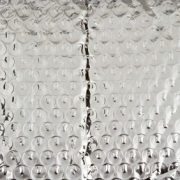
Written by The U.S. Department of Energy's Office of EERE Fri Mar 05 2010 4:37amReflective insulation systems are fabricated from aluminum foils with a variety of backings, such as kraft paper, plastic film, polyethylene bubbles, or cardboard. The resistance to heat flow depends on the heat flow direction. Reflective insulation is most effective at reducing downward heat flow.
Rigid Fiber Board Insulation
Written by The U.S. Department of Energy's Office of EERE Fri Mar 05 2010 4:53amRigid fiber or fibrous board insulation consists of either fiberglass or mineral wool and is primarily used for insulating air ducts in homes. It is also used when there's a need for insulation that can withstand high temperatures.