Solar Decathlon Spotlight: PRISPA House from Romania
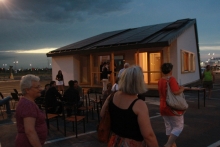
PRISPA House was one of only two Eastern European entries to Solar Decathlon Europe 2012, and it was the first such innovative project from Romania.
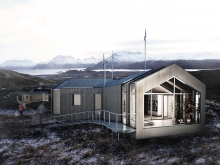
Spanish architects Taller Abierto won the Living Aleutian Home Design Competition 2012, which asked architects to design a creative, livable, affordable home in remote Atka, Alaska.
Data centers balance their growing power consumption with renewable energy initiatives.
Carbon offsetting, an effort to reduce overall carbon footprint, has seen some important changes in its implementation and practice.
Environmental Product Declarations (EPDs) describe the impact of products on the environment and help consumers to make informed, green choices. A life cycle assessment (LCA) made by a verified third party determines the EPD and facilitates the comparison of the environmental impacts of goods and services.
Changing the color scheme of your home or business can completely transform it. Colors communicate aspects of a personality or brand and have the power to produce psychological and physiological effects.
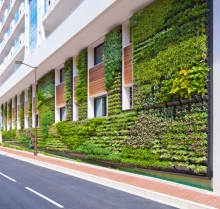
Many buildings are literally going green. The addition of a vertical garden, whether interior or exterior, has many benefits.
The benefits of gardening are numerous, but gardening also requires land – something that many commercial and urban settings lack. However, vertical gardening is a fairly simple way to enjoy the aesthetics of plants within a limited space. Vertical gardens grow upward alongside building exteriors and interior walls, creating captivating scenery where it would otherwise be impossible.
In this re-post from thegreencivilengineer.com, Bob Faulhaber confronts a tough question: “Am I a green hypocrite?” What answer do you get when you ask yourself this question?
Am I a green hypocrite? I might be... This is something that I struggle with quite regularly. I consider myself an environmentally responsible individual, and sustainability is a core tenet of the business that I founded. With just about every decision that I make, or at least the major ones, I try to consider the environmental consequences of that decision and action. However, I'd be lying if I said that I always made the environmental choice. Most of the time there is probably a good reason for that, but sometimes it’s really just a matter of preference. Does that make me a green hypocrite? I hope not, but I will leave that for someone else to decide. Here are some of my green and not-so-green decisions.
Six simultaneous construction projects on the Caltech campus require a balancing act on the part of the construction team.
Managing a single construction or renovation project on a college campus can be difficult, due to the extra consideration given to possible disturbances of lectures and student activities. When construction takes place in multiple phases in various locations throughout campus, the situation naturally warrants additional preparation. Six simultaneous projects have been underway at the California Institute of Technology (Caltech), a private research university located in Pasadena, California. Undertaking any major construction project at any learning institution necessitates taking such special considerations; the six projects at Caltech likewise needed to avoid disturbing campus life and to preserve the campus’s historic architecture.
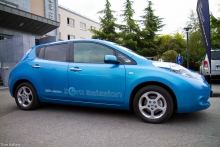
Electric vehicles provide a welcome alternative to gasoline-powered cars ... welcome, that is, as long as we are still able to fuel up as we travel. Take a look at current options available in the United States for charging while on the go.
When Eddy Grant came up with the lyrics to his 1982 hit “Electric Avenue” he likely wasn’t expecting people to actually be rocking down an electric highway just 30 years later. That's what people will be doing later this year on the West Coast Electric Highway (WCEH), a tri-state initiative that will form the longest electric vehicle (EV) charging network in the country, stretching along Interstate 5 from the Canadian to the Mexican border.
A conversation between two Seattle women sparked action that is now changing the lives of hundreds of young women, as well as a country. Suzanne McGill and Shal Foster founded the Rwanda Girls Inititative and, in partnership with MulvannyG2 Architecture, built a school that is now in its second year of operation and is providing a replicable model for future educational development.
During a marathon training run in 2008, two longtime friends and moms from Seattle began talking about the high-quality educational opportunities available to their children simply because they were born in the United States. The conversation eventually led to a discussion about Africa, a continent where only 13% of young women achieve secondary education due to poverty, lack of opportunity, and obstacles such as household chores and safety concerns. Suzanne McGill and Shal Foster began to wonder: What can we do to make a difference and help to provide educational opportunities for these young African women?
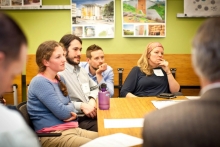
BRB Architects’ design for a new campus center at Molloy College is representative of a larger trend in campus planning: the shift from a commuter-only campus to a 24/7 community.
A commuter college is a college in which most students do not live in dormitories but commute from homes nearby. Community colleges are a common type of commuter college, but many private and smaller colleges and universities also fall into this category. In the past, students of commuter colleges have been present on campus only briefly as they attended classes; they would go elsewhere else to eat, lounge, study, and socialize. Now the atmosphere of many commuter colleges mirrors that of a more traditional college or university environment, where students do not just go to college to attend class but may meet with other students on campus for collaborative projects or simply for recreational purposes. As students begin to spend more time on campus and academic and social lives become increasingly integrated, the need for structural changes on many campuses has become more apparent.