David Ingold

David Ingold

David Ingold is a graduate of The Ohio State University School of Architecture and a member of the Construction Specifications Institute (CSI) with Construction Documents Technology (CDT) certification. With more than 18 years of experience, David brings a broad knowledge base and understanding of design and construction to a wide variety of project types. He is an accomplished senior project administrator with experience in developing all phases of architectural documents. David has performed key responsibilities as a project leader, specifications writer, and coordinator for projects of all types and complexities including low- and high-rise condominiums, sporting facilities, higher education and government research laboratories, manufacturing facilities, wastewater treatment plants, parking garages, and campus master plans. David’s greatest aspiration  is to provide construction administrative services to fully execute project designs.

Website URL: http://buildipedia.com/channels/on-site

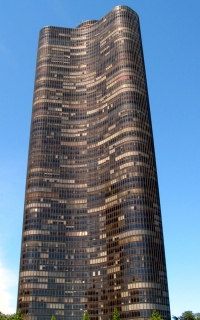
Today’s modern mid rise and high rise luxury condominiums and apartment buildings offer numerous amenities to attract potential owners. They can offer spectacular vistas through floor to ceiling walls of glass, high end finishes on the floor, gourmet style kitchens with all the modern features one could ever want, and a master bedroom suite that offers a tranquil and quiet place to escape. In these building types, elevators become a necessary component for vertical circulation to access the floors. For those residences that are adjacent to the elevator equipment room or the elevator hoistway, the noise and vibration caused by the operation of the elevator can be a potential source of sound intrusion. Because today’s buildings are constructed with lightweight materials, and because there is a need to generate maximum useable square footage, sound transmission issues are compounded. All this combined can result in unsatisfactory living conditions for tens of thousands who live in condominiums or apartments.
Thu Feb 02 2012 2:23pm

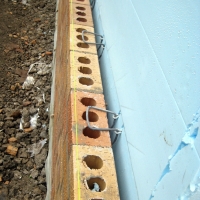
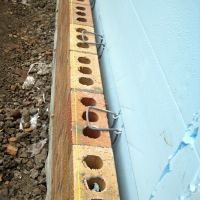
Metal Stud Wall System Anatomy

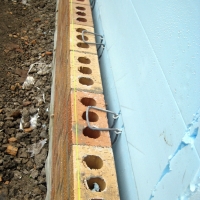
Concrete masonry units (CMU) have long been considered the ideal backup material for brick facing; however, because of increasing installation costs, CMU backup systems have given way to metal stud backup systems. Brick veneer with metal stud backup walls, because they are a very cost effective and versatile wall assembly, are very commonly seen in today’s commercial buildings.  The original exterior metal stud wall systems of the 1970’s were simple. They consisted of metal studs at 16 or 24 inches on center, with fiberglass batt insulation having an integral vapor barrier placed in between. Gypsum board sheathing was placed on each side, and 15 pound felt paper was installed over the exterior sheathing.  This system eventually would fail and allow air and moisture to enter the building, degrading the insulation and thus the R-Value of the wall, not to mention causing other significant problems.

The Brick Industry Association (BIA) has issued a revised Technical Note #28B that describes in detail Brick Veneer/Steel Stud Wall Construction.  The following is an abbreviated summary of their minimum recommendations:

  • The allowable out-of-plane deflection of the studs due to service level loads should be restricted to L/600 to L/700.
  • The minimum air space should be increased to 2 inches.
  • Ties must be spaced closer. There should be one tie for each 2 sq ft (0.18 sq m) of wall area.
  • Sheathing should be upgraded. Possible choices include: closed-cell rigid insulation meeting ASTM C 578 or C 1289 at a minimum of 1/2" thick; exterior grade gypsum sheathing, OSB or glass fiber mat-faced sheathing or cement board at a minimum of 1/2" thick.
  • A water-resistant barrier should be installed over sheathing.

Brick veneer with metal stud backup is typically a vented wall system.  This is to provide a way out for any moisture that enters the wall system through the brick joints or other openings.  A vented cavity also allows for pressure equalization of external pressures caused by wind loads. Venting is accomplished by providing weeps or vents immediately above the wall flashing. Open head joint weeps are recommended with a spacing of no more than 24 inches on center. BIA recommends that wick or tube weeps, when used, be spaced no more than 16 inches on center.

BIA recommends four types of adjustable masonry anchor assemblies for brick veneer/metal stud systems. Each of these is connected to the studs with metal screws. Due to thermal bridging at the stud, condensation can form on the inside face of the stud’s outside flange during long term cold conditions if a thermal break is not provided.  When using XPS as part of the exterior system, brick ties that connect directly to the framing must not rely on the compressive resistance of the exterior sheathing material to transfer positive wind loads to the steel studs.  This will eliminate the thermal bridge issue at brick ties.  All anchors must be embedded at least 1 1/2 inches into the brick veneer with a minimum mortar cover of 5/8 inch to the outside face of the wall.

A building's wall system must constantly fight the invasion of rain, air, vapor and thermal attacks.The wall's ability to provide a barrier to each of these elements relies upon the use of appropriate materials, installed in the correct sequence.  There is no such thing as a perfect wall system; however, a wall system that performs with greater efficiency using new efficient materials is achievable.

Designing and Installing a Safe System
Almost every commercial and public building, whether it is an office building, sports arena, place of worship, or school building, contains a guardrail system. Guardrail systems are installed to provide safety and protection for the building occupants and are placed at or near the outer edges, of flights of stairs, ramps, landings, platforms, balconies and accessible areas of roofs. They will also be found at the perimeter edge of any opening or accessible surface, such as an open­ing for a stairway, or at a location where operating conditions require limited access to a designated area in order to guard against accidental falls.

Thu Feb 02 2012 2:19pm

Demolition Best Practices

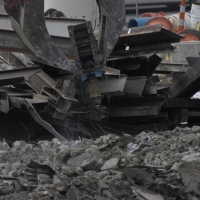
Demolition projects can range from small, simple jobs to complicated undertakings that require sophisticated and detailed planning. Site conditions can vary significantly, and there is always a degree of imprecision to the wrecking of the building itself. For typical building demolition and site improvements the most common procedure is to use heavy mechanical equipment such as wrecking balls, excavation hoes, grapples, pulverizers, crushers, and hydraulic breakers and shears. Several factors need to be considered prior to and during demolition, including the scheduling of demolition activities, protecting the site (especially important with occupied structures), and dealing with hazardous materials.

Tue Jun 15 2010 12:00am

Bing Thom's Arena Stage Expansion

I recently had the opportunity to visit Bing Thom’s much talked about and long-awaited Arena Stage renovation and expansion project in Washington, D.C. With slightly more than two years of construction completed, the $125 million, 200,000 square foot project is in the final stages and is due to open its doors on schedule for the inaugural 2010/11 theater season later this fall.

Tue Apr 13 2010 12:00am

Demolition Best Practices

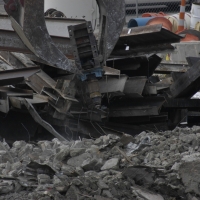
Demolition projects can range from small, simple jobs to complicated undertakings that require sophisticated and detailed planning. Site conditions can vary significantly, and there is always a degree of imprecision to the wrecking of the building itself. For typical building demolition and site improvements the most common procedure is to use heavy mechanical equipment such as wrecking balls, excavation hoes, grapples, pulverizers, crushers, and hydraulic breakers and shears. Several factors need to be considered prior to and during demolition, including the scheduling of demolition activities, protecting the site (especially important with occupied structures), and dealing with hazardous materials.

Designing and Installing a Safe System
Almost every commercial and public building, whether it is an office building, sports arena, place of worship, or school building, contains a guardrail system. Guardrail systems are installed to provide safety and protection for the building occupants and are placed at or near the outer edges, of flights of stairs, ramps, landings, platforms, balconies and accessible areas of roofs. They will also be found at the perimeter edge of any opening or accessible surface, such as an open­ing for a stairway, or at a location where operating conditions require limited access to a designated area in order to guard against accidental falls.

A building's wall system must constantly fight the invasion of rain, air, vapor and thermal attacks.The wall's ability to provide a barrier to each of these elements relies upon the use of appropriate materials, installed in the correct sequence.  There is no such thing as a perfect wall system; however, a wall system that performs with greater efficiency using new efficient materials is achievable.

The residents and businesses of Columbus, Ohio have another chance to capitalize on an incredible opportunity. The Columbus Dispatch recently reported that NASCAR racer Jeff Gordon will team up with Arshot Investment Corp to propose plans for a racing facility at the existing vacant Cooper Stadium. Cooper Stadium has been vacant since the Columbus Clippers moved to their new home at Huntington Park at the end of the 2008 season. There is no doubt this project will provide the economic jump-start that this part of town needs.

Page 1 of 2

Copyright © 2012 Buildipedia.com™ | All Rights Reserved
Site Designed by Kinopicz American