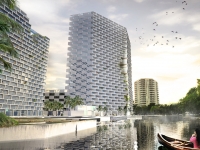
BIG's Mixed-Use Marina Lofts in Fort Lauderdale
Mon, Apr 15, 2013Marina Lofts, a new mixed-use development by Bjarke Ingels Group (BIG), will enliven a formerly industrial site along the waterfront in downtown Fort Lauderdale, Florida.

Murrye is a freelance writer based in New York City. She holds a Bachelor's degree in Architecture from the University of Arkansas and is a LEED-accredited professional. Her work has been published in Architectural Record, Eco-Structure, and Architectural Lighting, among others. She also serves as a contributing editor for the American Institute of Architects' New York Chapter publication, eOculus.
Marina Lofts, a new mixed-use development by Bjarke Ingels Group (BIG), will enliven a formerly industrial site along the waterfront in downtown Fort Lauderdale, Florida.
2012 surprised us with some of the most innovative and original architectural builds to date. Here are our top 10 moments from 2012.
Architect Tracy A. Stone’s expertise in historic preservation guided her renovation of a 123-year-old carriage house near downtown Los Angeles.
These eight tips on multi-tasking rooms will help you to maximize your small space.
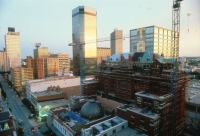
David M. Schwarz Architects (DMSAS)'s Sundance Square project is a masterplan to revitalize 35 blocks of downtown Fort Worth, Texas.

The Beverly Willis Architecture Foundation hosted a forum with featured speaker and futurist Edie Weiner, who outlined the eight opportunities for growth she sees for the AEC industry in the years to come.
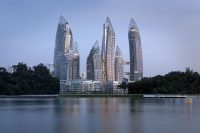
Daniel Libeskind softened his signature approach when designing a symphony of curving residential towers along Singapore’s waterfront.
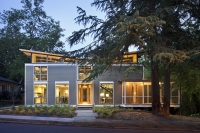
RainShine is the first modernist LEED Platinum house in the Southeast, according to architect Robert M. Cain.
Retired couple Chuck and Mary Bosserman purchased a lot near downtown Decatur, a suburb of Atlanta, Georgia, with the goal of building an energy-efficient home filled with natural light, cooled by cross-breezes, and supportive of their active lifestyle. However, they accomplished much more than that. Their vision, executed with the expertise of architect Robert M. Cain, AIA, LEED AP, resulted in a home that exceeds LEED Platinum standards – the greenest level of certification in the organization’s pilot program for homes. Dubbed “RainShine,” the home uses nearly half the energy of its traditional counterparts, and its modern aesthetic has attracted the attention of the community, creating opportunities for education.
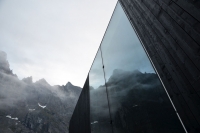
The Trollveggen made Architectural Digest's list of 10 most beautifully designed restaurants – read more about the visitor center and cafeteria elevated by its modernist architechture.
Reiulf Ramstad Architects designed a new tourist center and restaurant at the base of the Troll Wall, Europe’s tallest rock face. The form and material palette of the center mimics its stark landscape, and the resulting design is so dynamic it just might steal the show.
Tourist centers with restaurants are necessary and inevitable fixtures along scenic roadways. Usually they are utilitarian structures that peddle gaudy souvenirs and greasy food. However, in Norway, road-trippers have a more modern and elegant option when it comes time to make a pit-stop. The new tourist center situated at the base of Norway’s Troll Wall, or Trollveggen—Europe’s tallest vertical rock face, located in the Romsdal Valley along the western side of the country—is a welcome exception to this tired typology.
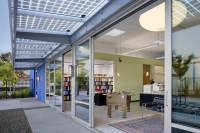
The International Living Future Institute unveiled its Net Zero Energy Building Certification program in October 2011. In April 2012, the ILFI announced that it had awarded its first two certifications under the program.
Meeting any set of sustainable building standards is a challenge, but to reach net zero status – supplying 100% of a building’s energy needs through on-site renewable sources – is surely the Holy Grail of green design. The Living Building Challenge, a third-party certification program offered through the International Living Future Institute (ILFI), has recently launched the Net Zero Energy Building Certification option, and two projects have already attained certification. This program is not just another set of checklists, however. Following the poetic analogy of a flower, the ILFI uses the dandelion as a logo and emphasizes beauty, collaboration, and curative properties, giving back to the community and paying it forward.
