04 22 00 Concrete Unit Masonry

Concrete Unit Masonry

Written by David Ingold Fri Jul 31 2009 1:43pm

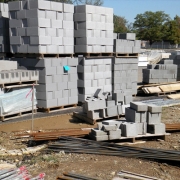
Concrete unit masonry is a form of masonry which uses prefabricated concrete blocks, including hollow or solid architectural concrete masonry units (CMU). To be considered solid, units must be at least 75 percent solid. Hollow concrete units are preferred because of the reduced weight, easier handling, and lower cost.Concrete masonry units are made from hydraulic cement, water, and mineral aggregates with or without the inclusion of other materials. CMU are molded using a relatively dry mix of cement and aggregates; they are compacted and consolidated using low-frequency, high-amplitude vibration, and then cured under controlled temperature and humidity. These units are suitable for both loadbearing and non-loadbearing applications.

Architectural Concrete Unit Masonry

Written by David Ingold Fri Jul 31 2009 1:45pm

Architectural concrete unit masonry is used as an architectural finish for interior and exterior walls, partitions, terrace walls, and other enclosures. Decorative CMU with textures, patterns, or other special finishes may be chosen for aesthetic attributes. Some units are available with the same treatment or pattern on both faces, to serve as both exterior and interior finish wall material.

Molded-Face Concrete Unit Masonry

Written by Buildipedia Staff Wed Oct 14 2009 6:53pm

Molded-face concrete unit masonry is a scored concrete masonry unit which is manufactured with one or more vertical scores on the face to simulate additional mortar joints in the wall. Scored units reduce the perceived scale of the masonry while still allowing construction using full sized units.

Prefaced Concrete Unit Masonry

Written by Buildipedia Staff Wed Oct 14 2009 6:54pm

Prefaced (glazed) concrete unit masonry uses blocks manufactured by bonding a permanent colored facing (typically composed of polyester resins, silica sand and various other chemicals) to a concrete masonry unit, providing a smooth impervious surface. The glazed facings must comply with ASTM C 744, Standard Specification for Prefaced Concrete and Calcium Silicate Masonry Units, which contains minimum requirements for facing quality and dimensional tolerances. In addition, the unit to which the facing is applied must comply with ASTM C 90 when used in loadbearing applications. The glazed surface is waterproof, resistant to staining and graffiti, and highly impact resistant, as well as being resistant to many chemicals and bacteria. Special admixtures and mortars are available for use with glazed units that provide better stain, bacteria, and water penetration resistance. Glazed units are available in a variety of vibrant colors: pastels, earth tones, and even faux granite and marble patterns. They are often used for brightly-colored accent bands, or in gymnasiums, rest rooms, and indoor swimming pools where the stain and moisture resistant finish reduces maintenance. Kitchens and laboratories also benefit from the chemical and bacteria-resistant surface.
Split-Faced Concrete Unit Masonry

Written by Buildipedia Staff Wed Aug 19 2009 1:16am

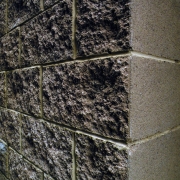
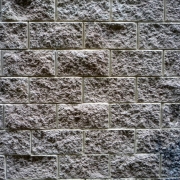
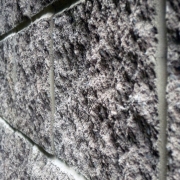
Split-faced concrete unit masonry is an architectural concrete masonry unit that costs a bit more than a standard CMU. It is made from a mixture of Portland cement, water, aggregates, and admixtures such as coloring agents, air-entraining materials, accelerators, retarders, or water repellents. Once shaped, compacted, and cured, the solid or hollow concrete units are then split crosswise or lengthwise. This random splitting allows some of the aggregate to break through in various planes, providing a look similar to natural stone.


Exposed aggregate concrete unit masonry, also described as "burnished" or "honed", uses ground face concrete masonry units that are polished after manufacturing to achieve a smooth finish which reveals the natural aggregate colors. The units have the appearance of polished natural stone. The finished look of the ground surface can be altered by changing aggregate type and proportions. Often, specific aggregates will be used to enhance the appearance of the polished surface, while coatings are sometimes used to deepen the color. Ground face units are often scored to achieve a scale other than the conventional 8 x 16 in.

Sandblasted face units are CMU where sand (or abrasive) blasting is used to expose the aggregate in a concrete masonry unit, resulting in a "weathered" look.

Fluted Concrete Unit Masonry

Written by Buildipedia Staff Wed Oct 14 2009 6:52pm

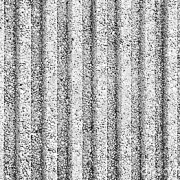
Fluted concrete unit masonry has ribbed or fluted edges. Units typically have four, six, or eight ribs vertically aligned to form continuous segments in the finished wall. The fluted units can be smooth, split, or striated. Flutes can be produced to provide either a circular or rectangular profile. Fluted concrete masonry units can be specially fabricated to be water repellent, and are produced in an array of colors.

Fluted concrete masonry units are usually laid so that the flutes or ribs align vertically as they are placed. Masons can utilize different bond patterns, such as stack bond or one-third running bond, to align scores in adjacent courses. The bond pattern used will determine the load bearing capacity of the wall.

Copyright © 2012 Buildipedia.com™ | All Rights Reserved
Site Designed by Kinopicz American