33 40 00 Storm Drainage Utilities

Catchbasins

Written by Buildipedia Staff Wed Oct 14 2009 2:20pm

Culverts

Written by Buildipedia Staff Wed Oct 14 2009 2:20pm

Storm Drainage Utilities

Written by Buildipedia Staff Wed Oct 14 2009 2:11pm

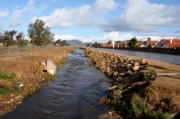
Rainfall on impervious surfaces such as paving and roof structures will result in storm water run-off.  Successive site improvements will trigger a requirement for an engineered system to thoughtfully manage storm water run-off.  In improved locations such as new suburban subdivisions, the amount of run-off is significantly increased compared to that of the previously undeveloped acreage.  Storm water management is achieved through storm drainage utilities, which are comprised of a physical network of site grading, curbs, culverts, catch basins, piping, manholes and, sometimes, retention or detention ponds.  Another aspect of storm water management is government regulation, which may impose water quality discharge standards and limits on how much site improvement can be authorized at sensitive project locations.

Ponds and Reservoirs

Written by Buildipedia Staff Wed Oct 14 2009 2:12pm

Reservoirs are used for storing a supply of usable fresh water. They are most commonly created by damming a natural surface water tributary in an existing basin, but they can be artificially constructed as well.  Water stored in reservoirs can have various functions, including serving as a source of potable water, irrigation, recreation and hydroelectric power.  Reservoirs are designed and evaluated based on their storage capacity, which is commonly measured in acre-feet.  Changes in reservoir storage capacity over a given time period are defined by an assessment of inputs and outputs.  Inputs include tributary inflow, precipitation, and water from groundwater flow nets.  Outputs are made up of draw-downs for irrigation and potable water, regulated flow to release excess storage or provide turbine power, and losses due to evaporation and seepage.  Reservoir (and pond) covers and liners are sometimes used on a smaller scale project to prevent losses from surface evaporation and seepage into the containment basin.  Subsurface water stored in soils as groundwater or in aquifers is a variation of the reservoir concept.

Residential Rain Barrels

Written by Jeff Calcamuggio Thu Feb 02 2012 1:56pm

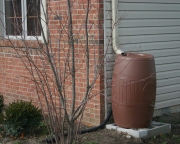
Rainwater can be harvested with large, sophisticated, complex systems, linked rain barrels, or a single rain barrel. A single rain barrel is typically installed under a downspout as a repository for the rainwater collected by the roof gutters.

Just Say NO ..... to Detention Ponds

Written by Bob Faulhaber Thu Feb 09 2012 11:21am

Civil engineers design them, landscape architects loath them, developers wonder why we need them and municipal engineers often require them - I hate them. Retention and Detention ponds have become the standard for stormwater management on commercial and residential projects throughout most of the US. They were originally intended for flood control and were later incorporated into water quality requirements as well. They serve in their capacity to attenuate peak flows from new development reasonably well, but their usefulness stops there. Here are a few of the reasons that I'm not a fan of detention/retention ponds:

The American Society of Civil Engineers (ASCE) includes Levees on its 2009 Report Card for America's Infrastructure, giving them a D–. The category of "Levees" covers major flood control works. However, what about the water that causes the flooding that levees protect against? Throughout drainage basins comprising thousands of square miles, stormwater runoff makes its way downstream. Obviously some systems convey that stormwater and even control it. ASCE says nothing about these storm sewer systems, but they form a vital part of America's infrastructure.

Zach Kent is a stormwater engineer for Modular Wetlands in Oceanside, California. We learned about Modular Wetlands’ urban wetland unit in our case study, “Water Quality Retrofit and Retaining Wall Remediation.” We've partnered with Kent to provide a perspective on some dynamics within the stormwater management industry over the last decade, including new processes and technologies designed to meet higher regulatory standards.

The City of Takoma Park, Maryland, needed to replace a failing retaining wall that supports a roadway in a small residential development. The Linden Avenue site is directly adjacent to Sligo Creek, which is a tributary of Anacostia Creek, a river undergoing a significant restoration effort. T. E. Scott & Associates, Inc., designed a replacement for the failing retaining wall infrastructure, created a pocket park for the local residents, and provided water quality treatment for the unmanaged watershed. This combination of aesthetic and environmental improvements adds value to the project. We’ll look at some stormwater flow design calculations, a storm water flow splitter, an urban modular wetland unit, a step/plunge pool, and an interesting retaining wall design.

In most cases, property owners are required by regulation to maintain pond embankments and outfall works as related to structural integrity and dam safety. Proper maintenance also lessens the liability of pond and lake ownership by reducing the likelihood of failures that can impact downstream property. Owners or property managers may believe that proper maintenance is occurring only to later learn that they need expensive repairs. This situation illustrates that many contractors providing routine maintenance, such as landscapers, are not trained to properly identify issues that can be problematic or lead to increased cost of ownership.


Copyright © 2012 Buildipedia.com™ | All Rights Reserved
Site Designed by Kinopicz American