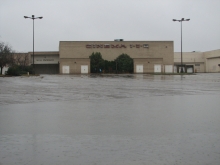
The recent news that Best Buy would be closing 50 stores renewed concerns about how this kind of large, empty space could be reused and sparked discussion about the fate of big box retail in general.
What strikes fear in the hearts of those concerned by urban sprawl more than the ubiquitous big box store? Quite possibly, those same big boxes standing empty (case in point: the exhibit “Dark Stores” by photographer Brian Ulrich). "Dark Stores" is the final piece of Ulrich’s three-part series Copia, an extensive study of American consumerism that was shown recently at the Cleveland Museum of Art, and it portrays a haunting array of now-empty retail venues.
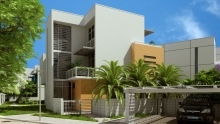
Staff housing for the U.S. Embassy in Port-au-Prince, inspired by the colorful forms found in local art, is designed to be sustainable and also resistant to seismic forces.
Sorg Architects, an international architectural firm, has created sustainable staff housing for U.S. Embassy staff members stationed in Port-au-Prince, Haiti. Construction on the housing units will begin in March 2012 and is scheduled to be completed in January 2014.
Architecture for Those Who Need It Most: The Parque Biblioteca España
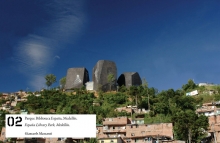
Written by Carlos Arango Fri Feb 03 2012 12:00amA "library park" in a Colombian barrio serves functions beyond those of either a library or a park. State-funded programs operated through the institution provide an underprivileged community with educational and other services, making the Parque Biblioteca España a symbol of hope for the city of Medellín.
Giancarlo Mazzanti’s Parque Biblioteca España is located in the city of Medellín, home to more than 3.3 million residents and capital of the coffee-producing province of Antioquia. The city is situated in the Aburrá Valley of the Andes Mountains, in the geographically diverse country of Colombia. Medellín runs the length of the Aburrá Valley, extending fingers and palms up steep slopes to the ridges that contain and proclaim its identity as a highland haven and, per the prevailing weather conditions, the City of Eternal Spring. Its unique geographic qualities allow the entire span of Medellín to be seen from the surrounding mountain ridges; conversely, these ridges can be seen from any point along the river bisecting Medellín’s core, the Rio Medellín. Along Medellín’s western slope in the Santo Domingo Savio barrio sits the Parque Biblioteca España, articulating through its rough-hewn envelope the city’s mountainous boundaries – a distinct point of pride for its inhabitants.

Sometimes, large-scale urban changes need to be made one step at a time. The concept of incremental urbanism is gaining traction in some communities.
Although economics and planning are considered sciences, it seems that "quality of place" is best captured when revitalization is approached as an art. Science is filled with models, many of which are all too familiar. However, it seems that many of the models employed in our economic revitalization efforts are just not working. As some groups try to identify a magic bullet that will turn around struggling (read: surviving) communities, others look to a more organic, connected solution that is better suited to our economic, political, and social culture. We talked with architect Alan Pullman of Studio One Eleven about the use of the incremental urbanism approach and its potential for revitalization.
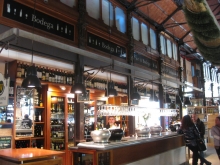
At the heart of any city is its marketplace. Madrid remakes some of its classic markets while adding modern twists.
Never one to be outdone by its neighbor Barcelona, Madrid is seeing its own market makeover craze. Two newly refurbished markets have risen from the brink of ruin to become the latest gourmet hot spots – the San Miguel Market and the San Antón Market.
Buildipedia asks Adam Strafaci of Autodesk about the changes that are coming to infrastructure design, how new software is entering the marketplace, and what the programs' users should expect.
3D computer modeling and, more broadly, the collaborative workflows that are being built upon that technology platform are changing the construction industry. The pace of change is so fast that it can be hard for professionals to stay on top of emerging trends. The Buildipedia community posed several design-specific questions to Adam Strafaci, Sr. Industry Marketing Manager of Infrastructure for Autodesk, Inc., the company that is the recognized leader in modeling software. Here Adam answers those questions and explains the latest major development – green infrastructure and its supporting software
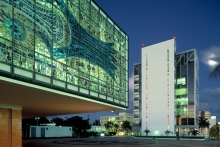
Buildipedia's interview with William Cary of the Miami Beach Planning Department sheds light on the city's development.
William Cary is the Assistant Director of the Miami Beach Planning Department. He is extremely knowledgeable about the city’s rich architectural history, and during his tenure, Cary has been influential in shaping the city into a magnet for notable modern architects. We spoke with him for our feature on the Evolution of Miami, but he provided so much interesting insight that we wanted to share more from that conversation.
Greenwich Village is a picturesque and predominantly residential community in Manhattan that is centered around Washington Square Park. Historically, it was a haven for artists, beatniks, musicians, and lots of students — it is the home of New York University (NYU).
Building the Better Block: New Urbanist Guerrilla
Written by Fernando Pages Ruiz Thu Aug 04 2011 12:00amPatience has never been a virtue of the young. Change is. But change has always come at a glacial pace and an exorbitant price when it involves land development. The dreaded bureaucracy of planning departments and city councils can chew up more time over debating a project than it takes to build it. No longer. What would normally take years of design and debate, a new guard of young, idealistic urban activists, including Jason Roberts, a self-described artist and computer consultant, and partner Andrew Howard, A.I.C.P. of Team Better Block, now accomplish overnight – or, at most, in 72 hours.
New York City Revitalizes the Life Between Buildings
Written by Greg Vendena Mon Jul 25 2011 12:00am(Thanks in part to Gehl Architects)
Over the past decade or so, New York City has been making dramatic improvements that emphasize the quality of life on the street, urban vitality, and sustainability. This is a most welcome shift that is part of a most welcome sea change. Specifically, the city has been carving out more spaces for pedestrians, bicycles, public transit, public gathering, and parks. New York City has no lack of pedestrians, and these improvements invite more. Planting a million trees and creating 200 miles of bike lanes are certainly New York City-sized moves. Like many cities, New York City is correcting the problems created by modernist planning and the predominance of the automobile, including damage to ordinary life for people on the street, where valuable urban vitality was traded for more lanes of traffic and parking lots.
Responsible Urban Planning: Old Ideas Are New Again
Written by Kristin Dispenza Mon Jul 18 2011 12:00amConsidered against the backdrop of human history, urbanization is a new phenomenon. For centuries, there was a commingling of agricultural, residential, and commercial functions – sometimes all three occurred under the same roof. The industrialization of the 18th and 19th centuries led inevitably to urban growth in the 20th century. Currently, the worldwide percentage of people living in urban areas exceeds 50%; in the United States, that number swells to more than 80%.
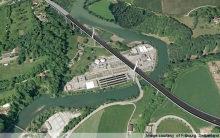
Tranquilo might as well be the motto of Madrid. It’s commonly used to tell someone to “take it easy” or “relax," perfect for these trying economic times. For those Madrileños who might find themselves a little stressed (and overheated) these days, the Madrid Rio project by West 8 Urban Design & Landscape Architecture has created a recreational zone along the Manzanares River that will allow people to enjoy an area previously referred to by many as “what river?”