

Pervious Pavement: Pavement that Leaks Like a Sieve
Written by Fernando Pages Ruiz Thu Feb 09 2012 12:00amContractor to Contractor: In this first of a two-part series, contractor-turned-homebuilder Fernando Pages Ruiz introduces permeable pavement, which allows rain and snow to seep into the ground.
What is Pervious Pavement?
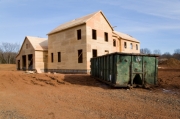
Pervious concrete came to the attention of the building community in the United States after Congress passed the Clean Water Act in 1987. With restrictions in the amount of storm water runoff permitted from roads, parking lots and other impermeable surfaces, some developers began to look for environmentally-friendly alternatives. They found it in an exotic, water-sucking concrete first tested in Florida about 30 years ago as a flood-control device. Engineers placed highly porous concrete paving in spots along Florida roadways frequently submerged by heavy downpours. The permeable surface provided a quick-drying roadway that didn’t stay flooded after the storm.
Through These Photographer’s Eyes: The Glass House, Part Three
Written by Robin Hill Wed Feb 08 2012 12:00amIn September 2011, publisher Rizzoli New York released The Glass House, a photo tour of Philip Johnson’s famous estate. The book includes text by Philip Johnson himself and by architecture critic Paul Goldberger, and is the official Glass House book of The National Trust for Historic Preservation. Robin Hill’s photo “Glass House Dawn” was selected to appear on the book’s cover.
Below is the final piece of a three-part installment wherein Robin Hill shares his experience of photographing the Glass House estate. View Part One and Part Two for the rest of the story.
My journey continues in its roundabout way, and I am now upon the gate -- the likes of which I have never seen before. It is most unusual. I try to find a historic connection to its design, but find none. What I do find is a beautifully scaled, welcoming structure that entices one to enter. It is everything that an entrance way to a gated community is not. Even when the barrier is down, it feels open. The Pillars rise high on both sides and are painted a welcoming tone of brown, quite different from the brown previously mentioned that smothers the library. Slung low across the bottom quarter is a brushed aluminum tube that splices the composition perfectly, both in terms of its height and its color. The gate is also quite a trick of visual play. There are actually four pillars, not two as is supposed from the full frontal view. The pillars on either side stand back to back with their identical twins behind them. This is a very clever way of hiding the gate mechanism that lifts and lowers the barrier. The wires are hidden from the front view, and delicately balance the barrier between the two pillars. The engineering is sublime, and gives a gentle equipoise to the whole structure. There are not enough ‘o’ s in the word smooth to describe this gate.
Through These Photographer’s Eyes: The Glass House, Part Two
Written by Robin Hill Tue Feb 07 2012 12:00amIn September 2011, publisher Rizzoli New York released The Glass House, a photo tour of Philip Johnson’s famous estate. The book includes text by Philip Johnson himself and by architecture critic Paul Goldberger and is the official Glass House book of The National Trust for Historic Preservation. Robin Hill’s photo “Glass House Dawn” was selected to appear on the book’s cover.
Below is the second of a three-part installment wherein Robin Hill shares his experience of photographing the Glass House estate. Read part one here.
Now I am making my way the few steps toward the lakeside pavilion. Here Johnson is up to new tricks. As I approach the lakeside, I am reminded of the London Underground loudspeaker system, which brusquely ejaculates "MIND THE GAP" every time you board or deboard a train. Instead of designing the pavilion to gently nudge the shoreline, there's this intentional but irritating gap that Johnson has deliberately placed in one's way. Why? My first thought is "to mess with your head" or perhaps it is to make you pay attention. OK, so now I'm paying attention, and the impression is that ordinary scale has been obliterated by the architect's hands. This is a perfect modern folly. It is barely functional, save to sit underneath and have an uncomfortable picnic. Through these photographer's eyes excellent framing opportunities are created by the multiple archways. The visual pun is too obvious for my taste, however, and the pavilion does nothing for me in an architectural sense. I begin to feel that this is a dud, a Johnson experiment that doesn't really work very well in either form or function. Perhaps, this is indicative of Johnson's uneven career as an architect, brilliant one minute and mediocre the next. In the space of a few steps I have gone from momentous elevation to ungarnished mediocrity, from design excellence to controlled vacuousness. Still, the adventure of being here leaves my intellect alone for a while and I am left in solitude in the middle of a 46-acre design campus. Heaven! There is a serenity here that is both palpable and meaningful.
Through These Photographer’s Eyes: The Glass House, Part One
Written by Robin Hill Mon Feb 06 2012 12:00amIn September 2011, publisher Rizzoli New York released The Glass House, a photo tour of Philip Johnson’s famous estate. The book includes text by Philip Johnson himself and by architecture critic Paul Goldberger and is the official Glass House book of The National Trust for Historic Preservation. Robin Hill’s photo “Glass House Dawn” was selected to appear on the book’s cover.
Below is the first of a three-part installment wherein Robin Hill shares his experience of photographing the Glass House estate.
A handful of iconic houses have reached the public imagination, and the Glass House is among the finest. In this transparent pavilion, surrounded by nature, Philip Johnson designed an architectural gem of quiet depth and epic simplicity. Its power arises from the Earth and exerts itself into a natural auditorium that can suffuse the visitor with a sense of grateful contemplation. It is a chapel in a cathedral of nature. One could be tempted into thinking that the Glass House is just a brown rectangular box with see-through walls, but to follow this line of thinking is to miss the point, because its simplicity hides a raw architectural sophistication that transcends an ordinary interpretation of space, providing the visitor with a unique opportunity to experience nature and architecture as a continuous whole.
Architecture for Those Who Need It Most: The Parque Biblioteca España
Written by Carlos Arango Fri Feb 03 2012 12:00amA "library park" in a Colombian barrio serves functions beyond those of either a library or a park. State-funded programs operated through the institution provide an underprivileged community with educational and other services, making the Parque Biblioteca España a symbol of hope for the city of Medellín.
Giancarlo Mazzanti’s Parque Biblioteca España is located in the city of Medellín, home to more than 3.3 million residents and capital of the coffee-producing province of Antioquia. The city is situated in the Aburrá Valley of the Andes Mountains, in the geographically diverse country of Colombia. Medellín runs the length of the Aburrá Valley, extending fingers and palms up steep slopes to the ridges that contain and proclaim its identity as a highland haven and, per the prevailing weather conditions, the City of Eternal Spring. Its unique geographic qualities allow the entire span of Medellín to be seen from the surrounding mountain ridges; conversely, these ridges can be seen from any point along the river bisecting Medellín’s core, the Rio Medellín. Along Medellín’s western slope in the Santo Domingo Savio barrio sits the Parque Biblioteca España, articulating through its rough-hewn envelope the city’s mountainous boundaries – a distinct point of pride for its inhabitants.
Sometimes, large-scale urban changes need to be made one step at a time. The concept of incremental urbanism is gaining traction in some communities.
Although economics and planning are considered sciences, it seems that "quality of place" is best captured when revitalization is approached as an art. Science is filled with models, many of which are all too familiar. However, it seems that many of the models employed in our economic revitalization efforts are just not working. As some groups try to identify a magic bullet that will turn around struggling (read: surviving) communities, others look to a more organic, connected solution that is better suited to our economic, political, and social culture. We talked with architect Alan Pullman of Studio One Eleven about the use of the incremental urbanism approach and its potential for revitalization.
6 Simple Ways to Make Your Home More Energy-Efficient This Winter
Written by Rachael Ranney Tue Jan 31 2012 12:00amEven if you rent your home, the six steps for winterizing are worth doing. They help save the planet… and save you money!
Whether you are a renter like me or own your own home, these simple steps will help you to prepare your home inside and out for these chilly winter months.
As Madrid’s population continues to expand, its suburban areas are becoming more and more popular with those looking for affordable housing outside the city limits. However, these neighborhoods, while more economically practical, have long been plagued with the cookie cutter design all too often seen these days. Full of generic residential developments and chain restaurants, these areas have very little character and no touristic value; as such, they have been dealt a short hand in the design game.