The Smith Center for the Performing Arts: Deco in Vegas
Written by Murrye Bernard Mon May 21 2012 12:00amDMSAS designs a new performing arts center that will outlast the $20 in your pocket.
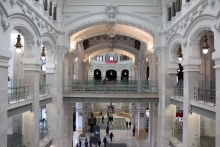
Las Vegas is known for its over-the-top re-creations of period architecture and, in some cases, of entire cities. Where else can you view interpretations of Caesar’s Palace, an ancient Egyptian pyramid, and modern-day New York City? The newest addition to Vegas’s collection of notable architecture is an Art Deco behemoth inspired by the nearby Hoover Dam.
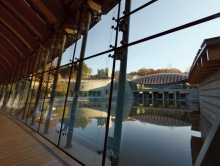
The Crystal Cathedral, designed by architects Philip Johnson and John Burgee in 1980 (with adjacent buildings by Richard Neutra and Richard Meier), will continue to serve as a house of worship, having been purchased by the Roman Catholic Diocese of Orange in 2011.
“Oh, I’m mad for religious buildings. The only thing that really gives you a kick in the world is a religious building.” The inimitable Philip Johnson was quoted saying these words in the iconic book on the architect by Hilary Lewis and John O’Connor, Philip Johnson: The Architect in His Own Words.
Case Study: Clinical and Translational Science Building, Part 1
Written by Lisa Taylor Mon May 14 2012 12:00amFrancis Cauffman designs a medical facility for the University of Rochester that unites research with practice.
This first article in a three-part series on the University of Rochester’s Clinical and Translational Science Building provides an overview of the workplace strategies Francis Cauffman used to integrate the 11 diverse departments of the Clinical and Translational Science Institute under one roof. Follow Buildipedia throughout the month of May to learn more about the engineering details of the building and how it achieved LEED Gold certification.
John McAslan + Partners created a canopied addition to the historic King's Cross Station, leaving the original western facade intact.
Heralded for its historical importance but rather drab, London’s King's Cross Station recently underwent a multimillion dollar redevelopment, reopening to the public on March 19, 2012. The newly overhauled King’s Cross Station was lit up in celebratory bright colors, creating a concert-like atmosphere – appropriate to its new youthful vibe. It was a timely redevelopment, as the XXX Olympic Summer Games will be held in London in 2012. The station’s western concourse, at 7,500 m2, is Europe’s largest single-span station structure. Each year 45 million people pass through King’s Cross Station, and that number is predicted to rise by 10 million by 2020.
Titanic Signature Project: An Exploration of Belfast's Shipbuilding Past
Written by J. Mariah Brown Tue May 01 2012 12:00amA new exhibition center in Belfast tells the story not only of the Titanic but of the long maritime history of this iconic city.
One hundred years after the RMS Titanic’s maiden voyage and tragic sinking, visitors of the Titanic Signature Project in Belfast, UK, will be able to delve deep into the story of the Titanic and Belfast’s rich ship-building history. The five-level, 12,000 sq. m. (129,166 sq. ft.) building features a glass-walled atrium, which leads visitors to various exhibits throughout the building. The lofty space with irregularly angled forms provides the perfect introduction for the displays that follow.
Minimalist Design of Cité de l'Océan et du Surf Museum Inspired by Sea and Sky
Written by Lisa Taylor Mon Apr 16 2012 12:00amSteven Holl Architects' design for a museum near the oceanfront in France is dedicated to the sport of surfing but also calls attention to issues affecting marine ecology.
Since opening in June of 2011, the Cité de l'Océan et du Surf Museum is quickly becoming an iconic tourist destination in Biarritz, France, due to its highly conceptual yet minimalist architecture, its integration with the coastal landscape, and its high-tech exhibits celebrating the leisure, science, and ecology of the ocean.
A new academic facility by OMA supports Cornell University's College of Architecture, Art, and Planning (AAP) while bridging several historic campus buildings.
As if designing space for an architecture school weren’t a complicated enough feat, try maneuvering around four historic buildings. OMA’s New York office designed an extension to Cornell University’s College of Architecture, Art, and Planning in Ithaca, New York, which officially opened last October. The modern yet reverent structure consolidates these previously separated programs and promotes interdisciplinary interaction within its open and flexible studios, critique spaces, plaza, and auditorium.
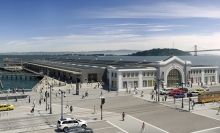
STV Group Renovates Hoboken’s Historic Ferry Terminal
Written by Kristin Dispenza Mon Apr 09 2012 12:00amSTV Group renovates a 1907 transportation hub in Hoboken, New Jersey, and puts ferry service back in place after an almost 45-year hiatus.
For a century, railroads dominated trade and travel in the United States. Train station architecture developed along with the rail industry itself, and in the early 1900s, every major city was building an ornate hub to call its own. Perhaps the most iconic – and one of the most short-lived – stations was New York City’s Pennsylvania Station. Built in 1910, much of the original Beaux Arts structure, which covered almost 7 acres, was demolished in 1963 to make way for Madison Square Garden and the rest of Penn Plaza. The demolition of the above-ground elements of NYC's Penn Station galvanized preservationists to save many historic stations.
Valley Performing Arts Center by HGA Architects and Engineers
Written by Murrye Bernard Tue Apr 03 2012 12:00amA world-class performing arts center harmonizes between town and gown, technology and energy-efficiency.
Located in Southern California’s San Fernando Valley, California State University’s Northridge campus (CSUN) is home to a new $125 million, 166,000-square-foot performing arts center. The Valley Performing Arts Center, certified LEED Gold, was designed by Minneapolis-based HGA Architects and Engineers, specialists in this facility type. The architects faced several challenges in creating a world-class center that incorporates advanced technologies without compromising energy efficiency and also redefines the campus edge while embracing the community.
Beset by problems early on, Herzog and de Meuron's Barcelona Forum building has become an admired work of architecture as well as a destination spot, situated as it is next to a busy convention area.
Let’s face it – it’s not easy to stand out architecturally in Barcelona. The city’s architecture portfolio includes some of the most diverse and historical architectural projects in the world. Antoni Gaudí’s exquisite creations, like the Sagrada Família, Casa Batlló, and Casa Milà, have firmly established Barcelona’s reputation as an architectural haven. However, it’s not all Modernisme and Gothic revival in this Mediterranean coastal city. In fact, Barcelona’s 21st century architecture has been making its mark on the city’s impressive architectural scene for years.
Case Study: Zaha Hadid Architects’ Riverside Museum of Transport and Travel, Part 4
Written by Lisa Taylor Mon Mar 19 2012 12:00amIn this article, fourth in a five-part series on Glasgow’s Riverside Museum, Event Communications showcases Glasgow’s transportation heritage in their design for the Riverside Museum’s historic collection.
Located along the banks of the River Clyde, Glasgow, Scotland is known for its rich heritage of international trade, transportation, engineering, and shipbuilding. In June of 2011, the city celebrated its vibrant history with the opening of the Riverside Museum of Transport and Travel, which features more than 3,000 objects, films, photographs, and personal testimonials dating as far back as the early 1700s.
Case Study: Zaha Hadid Architects’ Riverside Museum of Transport and Travel, Part 3
Written by Lisa Taylor Tue Mar 13 2012 12:00amDHA Design illuminates Glasgow’s Riverside Museum of Transport and Travel. This third article in Buildipedia’s five-part series on the Riverside Museum gives an in-depth look at the building’s lighting design.
In 2006, lighting consultancy DHA Design in London was appointed by exhibit firm Event Communications as the lighting designer for the iconic Riverside Museum of Transport in Glasgow, Scotland. For approximately three years, the two firms worked closely to design a lighting plan that would not only embrace architect Zaha Hadid’s overall vision and concept for the museum but also would complement the exhibition layout, which features more than 3,000 objects, films, photographs, and personal testimonials that reveal the vibrant history of the city of Glasgow.